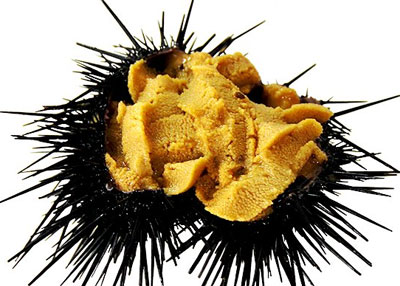
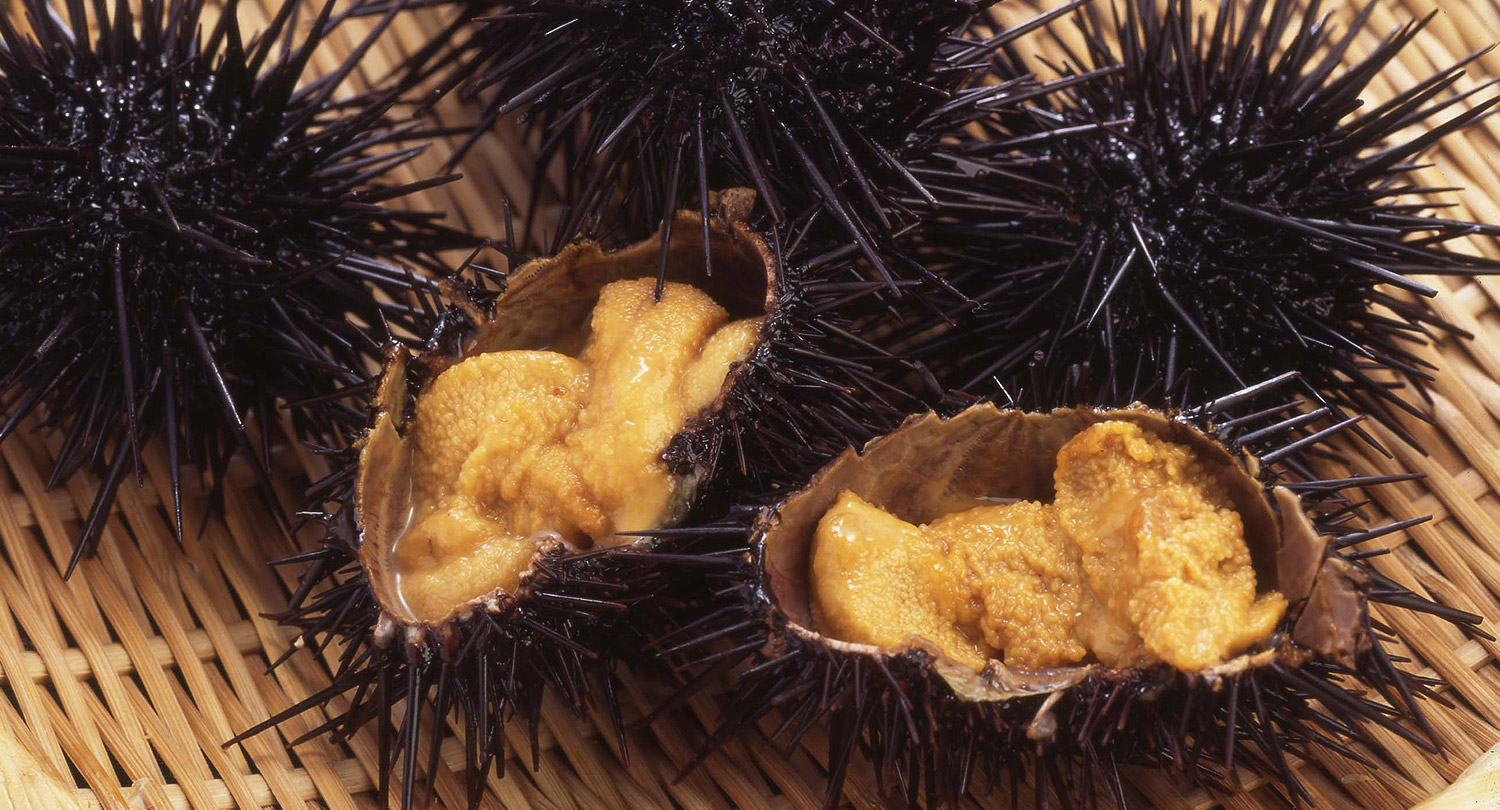
It is commonly referred to as the 'sex gland', but accurately speaking; it is not the roe of sea urchins but rather the edible portion of their reproductive organs (ovaries, testes). In Japanese, it is also familiarly known as 'uni,' and three different Chinese characters are used for 'uni' (although the pronunciation is the same).
The first is '海栗', a shape covered with spines like a chestnut. It is derived from the shape of live sea urchins resembling unopened chestnuts. It mainly refers to sea urchins in their unopened state.
The second one is '海胆' (haidan), which got its name because the edible part of sea urchins resembles internal organs (such as the liver). The character '胆' can also be pronounced as 'i,' and 'Umii' (Umi海Sea+I胆gallbladder) evolved into 'uni.' It refers to the state where the shell is removed, and only the reproductive organs of sea urchins are extracted, which is the most common yellow sea urchin we see. Generally, this character is widely used.
The last is '雲丹' (undan), which means red clouds. It is a Chinese character used to describe the shape of sea urchins processed into salt or alcoholic food products.
In Korea and Japan, common edible varieties of sea urchins include purple uni (紫海胆, Murasaki uni), round sea urchin (北紫海胆, Kita Murasaki uni), horse dung sea urchin (馬糞海胆, bahun uni), Ezo horse-dung sea urchin (蝦夷馬糞海胆, ezobahun uni), and pink sea urchin (赤海胆, akahuni).